Limor Zer Gutman
Council member
Lemaan HaMoshava Party
לימור זר גוטמן
חברת מועצה
סיעת למען המושבה
November 21, 2025
Hello, everyone.
This week, there are several topics that every resident must sit down and read. The future of our community will be shaped for many years to come by what happens today. So don’t turn a blind eye. And most importantly—please forward the newsletter attached to this email as a document—and make sure to add more and more people to the newsletter’s distribution list.
Send me their names and email addresses, and I’ll add them to the confidential distribution list.
First topic: A massive real estate project initiated by the council on a 3.5-dunam plot of land we own!! Where the large rear parking lot is currently located on the side of Zaztovnisky Street, below The Hobbit pub. Given that the Council is seeking in the tender only a minimum consideration of 1.25 million NIS + VAT for the entire plot (meaning the bidder who offers the highest amount and meets a series of conditions will win the tender), this is in addition to 170 parking spaces to be allocated to the Council. The question arises: Is it right to proceed under these conditions? And there are many other issues with this project that have not been brought up for discussion in the council or with the public. Please read on.
Second issue: The council engineer has been added to the list of department heads who have left or been dismissed since the start of Abutbul’s term. She’s been in the role for just a year and two months and is already leaving. Why?
Third issue: Do you also feel suffocated in the community by all the never-ending projects? It’s wonderful to renovate and upgrade infrastructure—but where is the management that will assure us residents that the project will be completed efficiently and that we’ll be notified before the construction equipment arrives on site?
Fourth issue: You are invited to the renovated Gan Tiul.
First topic: The Moshava Courtyards – what is the connection between the council head and the council’s advertising and marketing of a real estate project and the actual need, alternatives, and public benefit?
Last week, the mayor announced to the public that a tender had been issued for the development of the Moshava Courtyards complex.
Location of the real estate project: The rear section of the pedestrian mall between Jabotinsky Street and HaNadiv/HaMarhav Street. Where there is currently a large parking lot on the side bordering the Hobbit Pub and Danka Restaurant. Attached is a bird’s-eye view of the complex’s location.
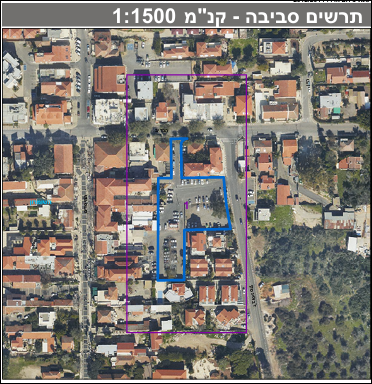
A project of this nature, as will be explained and described below, requires public discussion in the full council meeting, and there is even room to consider public participation before the tender is issued. A council head who likes to convene residents regarding traffic arrangements in various neighborhoods. All the more so, he would want to convene residents when it comes to a massive real estate project in the center of the town on public land that is public property. A project that will greatly impact businesses on the pedestrian street. But he is not convening a discussion, not even in the council. Why?
It is true that, according to the law, the council head is not required to obtain the plenary’s approval to issue a tender, but only after the winner of the tender has been approved; and since this is a public land transaction, the council plenary will be required to approve the agreement and the contract.
But by then it will be too late to hold a discussion that could change anything. The compliant coalition members will vote in favor of the contract and say, “We’ve already issued the tender, there’s a winner, and we’ve reached an agreement with them—so are we going to cancel it now?”
In a council operating according to proper administrative procedures and with minimal transparency, a large and complex real estate project of this kind must be presented at least to the full council members before the tender is issued.
Given that the council is seeking in the tender only a minimum consideration of 1.25 million NIS + VAT for the land (meaning the bidder who offers the highest amount and meets a series of conditions will win the tender), this is in addition to 170 parking spaces to be allocated to the council. The question arises: Is it right to proceed under these conditions?
We have already witnessed, during the previous terms of the council head, the wholesale sale of numerous public assets, including building lots and even historic properties, and this can be elaborated upon at a separate opportunity.
Background: This project has been under discussion since the establishment of the Wine Route. It involves two plots that were formerly part of the agricultural holdings of the Wilder and Leibovich families. Over 20 years ago, a land swap was carried out such that, in exchange for these plots transferred to the council, the families received alternative land of equal value.
A review of the tender published by the Council reveals that:
And these are just the tip of the iceberg when it comes to the problems and questions raised by this project.
After thoroughly researching the matter, I have many questions regarding this megalomaniacal project. And above all, one big question: What do we, the residents, get out of all this?
For example, one could explore elevated parking or a combined system with a single excavation level and elevators serving 2 to 3 sections; there are many solutions on the market today, some of which have been implemented in Israel. An example is attached for readers’ review. See, Parking Multipliers – Tzofia Engineering
In order to provide newsletter readers with as much information as possible, a link is attached to the zoning plan available on the Planning Administration’s Mabat website and to the tender documents published by the Council:
Zoning Plan 353-0363929 on the Planning Administration website
The published tender can be found on the council’s website
Zichron Yaakov Local Council – Tenders
Second Topic: Departure of the Council Engineer
This week I found out that the council engineer, Architect Ruth Barans, is leaving her position.
And you might ask, how do I know?
Don’t worry—the council chair didn’t update the council members. It’s possible via email.
I learned about this from browsing the council’s job listings website.
It is highly puzzling that after only a year and two months in her position, the engineer is leaving. And this is already a troubling trend where managers are leaving or being dismissed from their positions at the council or in affiliated bodies of the local authority, and the only ones harmed by this are us, the public.
Since Abutbul took office a year and a half ago, the following have left or been dismissed:
Turnover among managers is a natural part of any organization and can even have positive aspects. But here, the pace is so rapid that it raises questions—why?? Is this related to the fact that the managers are unwilling to engage in improper or illegal activities? I know that publicly, the Council Head issued an illegal directive not to respond to my emails, and he also does not allow employees to forward documents to me or review them. And these are illegal actions! Are there situations where employees are required to disobey the law? Who is willing to work in a workplace with such norms?
Third issue: Development projects—you can’t have your cake and eat it too, and it’s always the public that suffers
What we, the residents of Zichron Yaakov, are experiencing firsthand is systemic mismanagement—uncontrolled and without proper oversight. Projects are started but never finished, or the public isn’t even informed of their existence.
We are all in favor of developing and upgrading public buildings and infrastructure in the town.
Feel free to review the meeting minutes and see that I vote in favor only if all the required information is provided and questions are answered during plenary sessions. I vote in favor of the project, but its management is handled by one person and one person alone—the head of the local council. He feels no obligation to respond to my inquiries regarding ongoing projects.
The failures in many projects and the public’s lack of awareness regarding project implementation—even by other infrastructure entities such as the Israel Electric Corporation, the Water Corporation, and others—are extremely troubling, both in terms of financial cost and as a public nuisance.
Here are a few examples: the villa project in the Rehovot forest on Shazif, Yasmin, and HaTapuach streets; work to add parking in the Beit Ramaz neighborhood; the square at the intersection of Derech Aharon and the Halomot neighborhood (a project by the Ministry of Transportation that has been ongoing for six months); and other projects—which are dragging on. For a long time.
The Council does not update residents on projects such as the one carried out this week on Hendiv Street and the intersection with Herzl Street, where sidewalks, parking spaces, and crosswalks were blocked.
Without a professional public relations office (as exists in all local authorities in the area), an Israel Electric Corporation project is carried out for several days in the center of the town without the public’s knowledge. Or there is a power outage lasting nearly 5 hours throughout the town, and only a select few residents on the mayor’s mailing list receive an update on the outage and the duration of the repair—but no formal announcement is issued through the council.
In the end, it all boils down to a lack of professional management, which has been replaced by a troubling centralization where everything must go through the mayor, who makes all the decisions. Who knows, perhaps this is also a reason for the managers’ departure.
Topic 5: You’re Invited to the Renovated Gan Tiul
The work at Gan Tiul has finally been completed, and new playground equipment has been installed for the children’s enjoyment. The public is invited to enjoy this new experience. Thank you to the Security Department for carrying out the project.
