Limor Zer Gutman
Council member
Lemaan HaMoshava Party
לימור זר גוטמן
חברת מועצה
סיעת למען המושבה
January 16, 2026
Hello everyone,
Today’s newsletter will present the second part of the list of key issues I have addressed to date, along with their current status. It includes up-to-date information that is important for you to know regarding planning and construction.
Some issues are being resolved following my interventions; others require a long time to obtain accurate information and answers, and more work is needed; there are issues where people are hiding the truth and lying, and I still have more to expose and address. And there are issues like the first one below, which is ongoing and destructive to the community.
1. High-density construction in the heart of the town.
As I have already reported to you—there is a peak in the issuance of building permits. I continue to monitor the latest report from the Central Bureau of Statistics, which surveys the number of building permits in each community. The survey shows that the trend of a proliferation of building permits in Zichron Yaakov continues. Between January and September 2025, 205 permits were issued in Zichron Yaakov!!! And the data for the end of 2025 has not yet been received.
Attached is a graph by year. Please note that the 2025 column includes only 9 months, so the number of building permits for 2025 is expected to be even higher than this:
I would also like to remind you of the most troubling information that emerged from an inquiry I submitted this year, according to which the council filed zero objections—yes, zero formal objections—on behalf of the council to the Regional Planning and Construction Committee or the District Committee.
Conclusion: Over the past year, the reins have been loosened and construction is running rampant. Residents need to wake up.
Here is an example I addressed this year—
In Newsletter 25 (February 2025) and in a post I published on Facebook, I reported that the Regional Planning and Construction Committee approved, with the support of two local representatives (Abutbul and Elbaz)—a plan at the corner of HaNassi and HaOranim Streets, where 10 housing units will be built on an area of less than one dunam (only 880 square meters)! Three stories high (above a basement level). The side building lines have been reduced to two meters instead of four. This plan constitutes a massive deviation from the master plan, which allows only four units per dunam in this section of the town center.
Construction of this building is currently being completed, and here’s what it actually looks like. Both photos were taken this week from the front. Is this what the entire center of the town will soon look like—tall, dense, with insufficient parking? Look how it doesn’t blend in with the other houses. And especially, it doesn’t fit in with the historic part of our town—a part that should be preserved, not destroyed for the sake of developers’ profits.
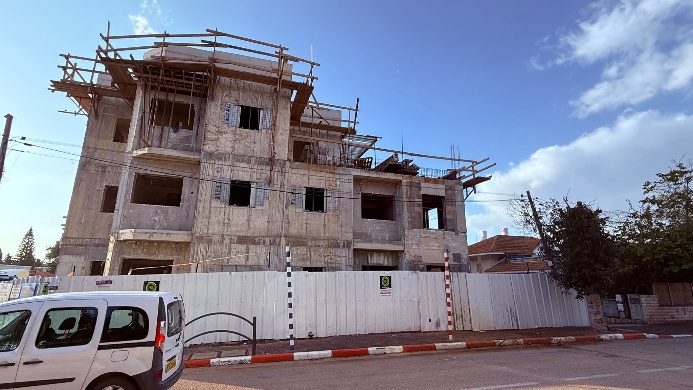
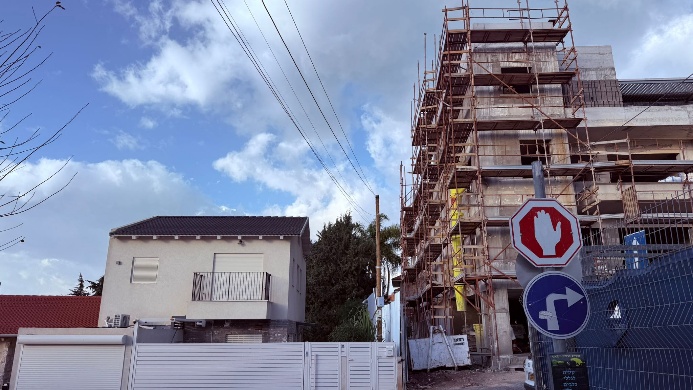
View from HaNassi Street View from Ya’avetz Alley
Did this massive building enrich the council’s coffers with betterment levies? Probably not really. Here’s the explanation: To the best of my knowledge, in cases of demolition and reconstruction under TAMA 38/2 (as with this building), the betterment levy is paid only for building concessions and not for the additional units. In this massive building, 6 units were added to the existing 4, raising the question of whether the developer paid betterment tax for the 6 additional units. Or, because this is TAMA 38/2, the developer did not pay betterment tax for the 6 additional units. And thus, the community was harmed twice: damage was caused to the public space due to dense construction without adequate infrastructure, and an appropriate betterment tax was not paid. Who benefits?
During Abutbul’s previous term (2013–2016), when he also served as the community’s representative on the regional committee, the plan for 34 Herzl Street was approved—12 units on 1.25 dunams! (Instead of 6 units according to Sh/12/B) For me, the most significant achievement during the outgoing council’s term under Ziv Deshe was halting the rampant construction in the center of the town and slowing down construction throughout the town in accordance with infrastructure development capacity. The outgoing council insisted that developers build only in accordance with the master plan or within the rights granted to them. For example, at 38 Herzl Street, the developer wanted 8 units per dunam—the council refused and filed an appeal that upheld the council’s position, leaving the project at 6 units. At 36 Herzl Street, the developer requested 6 units, to which he was entitled, and was approved for 6 in accordance with his rights. At 91 HaMeisadim Street, a developer requested 9 units under TAMA 38; the council objected, filed an appeal, and the developer built only 5 units. Now we have returned to 10 units per area of less than one dunam. I foresee and am certain that dozens more identical plans will be submitted in this area, Complex 3, which is the historic heart of the moshava.
See why insisting on building units in accordance with the master plan or zoning plan is important. In the following photo, also taken this week from the front, on the right is 34 Herzl Street—the building approved during the previous term when Abutbul served as a member of the Regional Committee’s plenary session—where 12 units were built on 1.25 dunams. On the left is the building at 36 Herzl Street, approved during the outgoing council’s term, which contains 6 units per dunam in accordance with the local zoning plan.
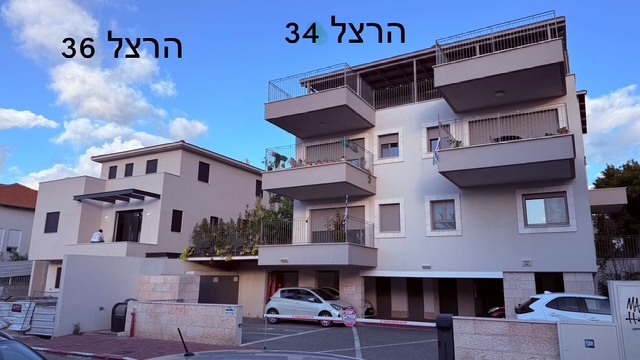
In my view, even 6 units per dunam is too dense—but that is what the plan approved for this area many years ago stipulated, and these were vested rights for the owners. But imagine the entire Herzl Street lined with buildings like 34 Herzl on both sides. We don’t have to. This would destroy the historic center of the town.
And in my view, this is the most important struggle of the residents and the opposition (I have no expectations from the coalition)—to prevent the densification of the town’s historic heart and the increase in developers’ profits.
2. The illegal blocking of the road connecting Wine Park to Malchei Yisrael and Barak Streets. Even though I exposed the council head’s lies and reached out to a number of parties and the media about this issue, the illegal “temporary” blockade remains. A handful of residents on Malchei Yisrael Street are benefiting from an election promise that has been fulfilled, effectively receiving a nearly private, closed-off street. This action comes at the cost of harming the interests of the majority of the public, who need another route to Neve Sharett and the Wine Park, and imposes additional traffic congestion on the narrow and already congested HaTirosh Street. I will continue to try to reverse this illegal action.
3. The Council built a two-story public building on HaPdot Street. The upper floor serves as a synagogue for the worshippers of the synagogue on Marvad HaKsamim Street, which was vacated as part of a demolition-and-reconstruction plan. The synagogue was transferred to the Religious Council’s jurisdiction and is currently in operation. But what is happening on the lower floor of the building? The synagogue is not supposed to take over this space, which is intended for public activities. I am continuing to investigate whether there are public activities taking place there or if it has become a profit-generating event hall for the synagogue. I am also looking into whether the Council transferred responsibility for managing the facility to the Religious Council in an orderly and proper manner. I submitted an inquiry on this matter and am awaiting a response at the next meeting.
4. Illegal posts on the council’s page and in the council’s information systems by the council head. The council head made unauthorized use of the authority’s digital resources, and despite my repeated appeals to the council—including personal delivery—I received no response. A petition was filed, and the association and I won the case. I was pleased to discover that the council head also reads this newsletter—I announced here that I intended to transfer the costs awarded to me to the association. And miraculously, the council and Abutbul paid everything directly to the association.
The association and I continue to monitor the publications and are prepared to file another petition if the violations of the law continue. I call on the council’s legal advisor to enforce the law and thereby save me and the council unnecessary work.
5. Ongoing monitoring of activities at the Zamarin Community Center. Here are a few matters I have addressed that are important to know regarding the Community Center.
At the budget meeting (where I voted against her appointment as deputy), it was explained to us that this is a role requiring a great deal of work and that the mayor does not have time for it, so it is important that Zila fill the role. However, the mayor is still the chair of the community center’s board. Until the community center’s bylaws—which define it as a municipal corporation—are amended, the deputy mayor cannot fill the role. By law, she is still prohibited from managing the community center. So who is actually managing the community center?
6. The road resurfacing project in the Villas neighborhood of Horesh, which began in August 2025 to resurface and pave the roads on three streets (Shazif, Shikma, and Tirosh), suddenly turned into a project to add rainwater drainage pipes, massive drainage chambers, and drainage ditches. The effort to upgrade the drainage system is commendable, but we did not actually approve it or the required budget for it at the council meeting, and it is unclear where the budgetary authorization to carry it out came from. When things are not handled in an orderly and managed manner, the ongoing project causes immense suffering to residents and physical damage.
7. The Moshava Courtyards project, which has been put out to tender. This refers to the large parking lot on Jabotinsky Street, below the Hobbit Pub, which is slated to be converted into two residential buildings and an underground parking garage. I am awaiting the discussion the council head promised to hold with council members, in which he will explain the tender and the entire development plan for the eastern entrance to the town. I have many questions to raise during the discussion.
8. The puzzling withdrawal from the joint employment zone. This is a 15-year plan to establish a joint employment zone in the area north of Zichron Ya’acov up to the Pardes Junction. A plan that is now close to implementation, and suddenly, like a bolt from the blue, the council head announces that Zichron Ya’acov is withdrawing from it. This comes after the Israel Land Authority has already invested millions in planning a project that would benefit all residents by creating a business hub that would generate revenue for the operating budget. There is no logic to this withdrawal. Here, too, I am awaiting the meeting on this topic that the council head promised to hold, as I have many facts to present there.
