Limor Zer Gutman
Council member
Lemaan HaMoshava Party
לימור זר גוטמן
חברת מועצה
סיעת למען המושבה
January 30, 2026
Hello everyone,
This Tuesday, February 3, 2026, at 6:00 PM, the Council meeting will take place. Attached is the agenda for the meeting, and as you can see, there are many topics for discussion. As always, the meeting is open to the public—and your presence is very important. This is an action you can take for the benefit of the entire community and the rule of law.
Even if you can’t attend, please review the agenda and send me any questions or information you have regarding the topics. I make sure to come to meetings well-prepared and to ask questions.
Three topics in this week’s newsletter:
A few years ago, an agreement was reached with the developer for 94 units, which was approved by the Urban Renewal Authority, and now he’s getting a gift, and the number of apartments has suddenly jumped to 134. It’s unclear how this happened. What is clear to me is that Tirosh Street—the Magic Carpet—and the entire southern housing complex are going to become crowded because this is not the only demolition-and-reconstruction project.
First topic: Continued increase in construction and density throughout the town, this time in the mega-project of demolition and reconstruction at the corner of HaTirosh and Marvad HaKsamim streets, where many details are being concealed.
I, and I believe you, the readers, all welcome demolition-and-reconstruction plans that allow for the renewal of urban spaces, improved housing for the local population, the addition of new residents across a diverse age range, the opportunity for young families to purchase their first home, and more.
But… a project of this kind must be carried out with a reasonable housing supply and full transparency. This is lacking in the mega-project that will be brought for approval by the full council this coming Tuesday.
First, the proposal is missing a lot of details. There is far more hidden than revealed. See Section 8 of the proposed agenda—five laconic lines describing a project with a massive impact on the neighborhood and the community. The council head is apparently convinced that his coalition will approve everything with their eyes closed, which is why he is submitting a plan for approval that lacks so many details. I searched the Planning Administration’s website and found nothing. Still, when submitting such a project for council approval, five lines in the proposal are simply not enough. Here is some of what is missing:
Look at the photo below; this is the area in question—Haitirosh Street at the intersection with Marvad HaKsamim Street. In the photo on the right, you can see part of the memorial garden dedicated to Avi Ben Harush and Hanit Armi, a son and daughter of the neighborhood who were murdered in a terrorist attack at the Binyamina train station. The mega-project will be built on this garden and the two buildings visible in the photo.
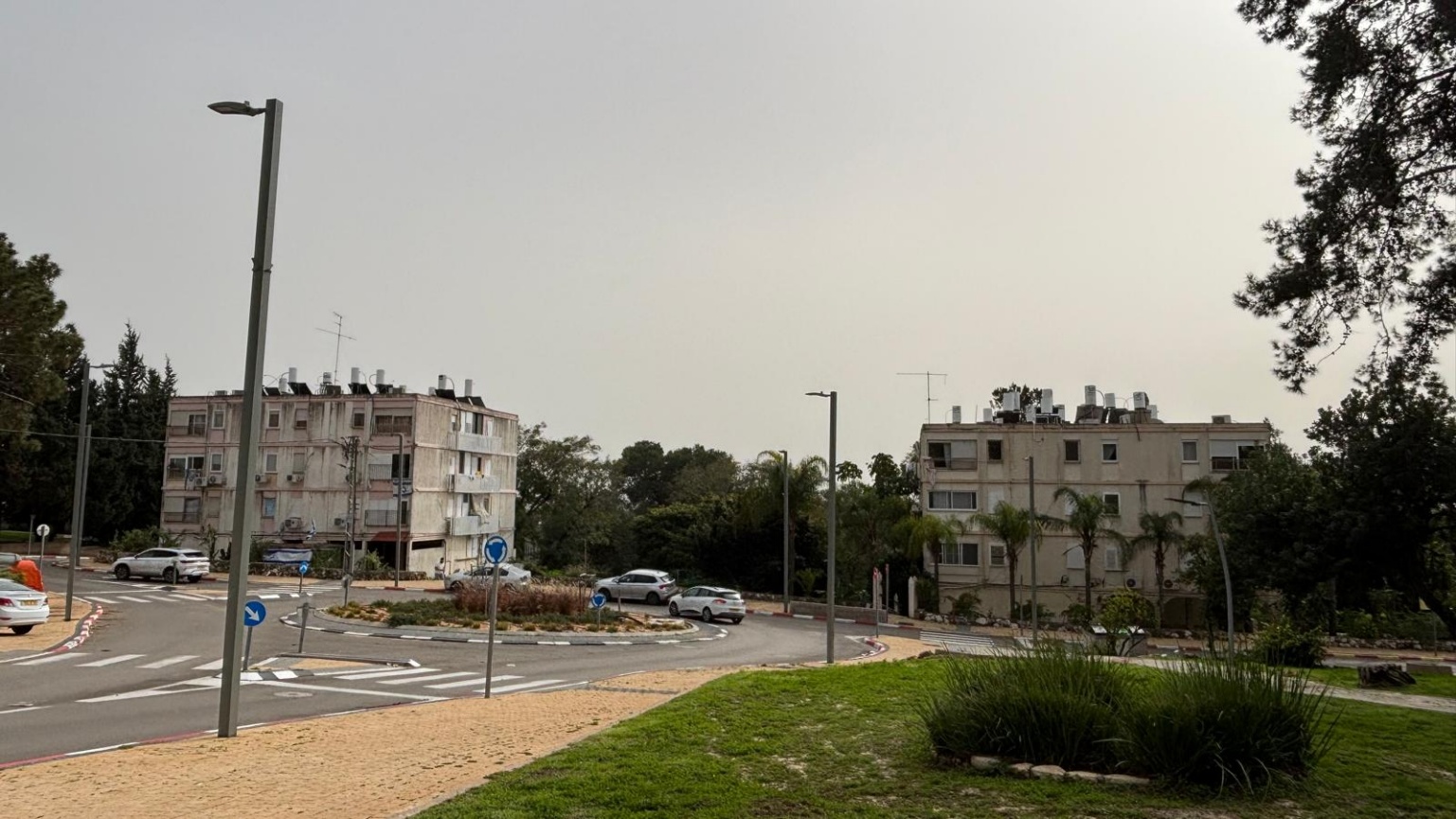
Today there are 28 apartments and plenty of green space there. According to the plan—which must not be approved—everything will be transformed into a complex comprising 135 apartments with commercial and public spaces. This means increased traffic and uncontrolled overcrowding at the central intersection in the Neve Sharet neighborhood.
Just for comparison, in the adjacent complex (the Railway Buildings on Marvad HaKsamim Street), where a demolition project for 36 units has already been approved—they will build 130 units. In other words, for every existing unit, approximately 3.5 new units will be built. Whereas in the new plan, for every existing unit, approximately 4.8 new units will be built.
The residents of the Sharett neighborhood must wake up, and so must the entire community.
Second topic: Tu Bishvat – environmental protection, promoting sustainability, and the community library project.
Tu Bishvat reminds us how important the environment is; we are temporary guests on Earth, and it is our duty to protect it. This was the philosophy that guided me during the year I served as chair of the Environmental Quality Committee until I was forced to leave. During my tenure, the committee met seven times—more than the minimum required by law, which is one meeting per quarter. The reason was my genuine desire, and that of all committee members, to advance important issues such as mitigating the urban heat island effect through various means, encouraging tree planting and preservation, proper recycling, reducing the hazard posed by fireplaces, and more.
To my great regret, the committee I chaired was unable to carry out its important work due to overt and covert lack of cooperation on the part of the mayor. For this reason, I resigned from the committee.
For several years now, I have been volunteering with a team of wonderful women who established and operate the community library on Ha-Hita Street. It is a library where people bring books they no longer need, and others borrow and return them. The council’s Environmental Quality Department is responsible for the community libraries, and the volunteer team at the community workshop located at 100 HaMeisadim Street assists in their operation.
These are the community libraries currently in operation:
This is an opportunity to ask that you bring only reading books for all ages to the libraries. Please do not bring textbooks, encyclopedias, or old, torn books—this only creates extra work for us to sort for recycling. Please put them directly in the recycling bin.
For several years now, we have been hoping to establish a community library in Givat Eden. I hope the Environmental Quality Department will move forward with this project in 2026, as community libraries are a tremendous success on every level.
Third issue: The case of the Great Synagogue Association, the illegal letter written by the Council Head to the Registrar of Associations, and the lack of response from the Legal Advisor despite the seriousness of the matter
Reminder: Since his previous term, the council head has supported the construction of an event hall on historic land adjacent to the Great Synagogue in the center of the town. This area is entirely a national heritage site. Who will benefit from the event hall? However, this is not an ordinary synagogue; it belongs to the local council and is designated a national site. It is a historic site belonging to the Jewish people.
In August 2024, the association registered its address at 16 HaNadiiv Street, Zichron Yaakov. This is the address of the synagogue, which actually belongs to the council. The association cannot list its address at a property that does not belong to it and has not been allocated to it. Or, if no other legal agreement with the council was signed by the registered date, this is an illegal act. The council head himself stated at the council meeting on February 4, 2025, that this is illegal.
He said this even though he already knew at that point that he himself had approved this illegal action in a letter six months earlier!! The Registrar of Associations would never agree to register the association’s address at a property that does not belong to you or that has not undergone an allocation process or other legal procedure. Unless the property owner—which is the council—agrees to it.
And here is the approval from the property owner—the letter written by the council chairman. Note that the letter is not written on official council stationery, which would have required documentation in the council files and would have been known to the legal advisor; no one from the council administration is copied on it, and especially not the office holders!!! And it has no date. But he signs as the council head because otherwise the Registrar of Associations would not have agreed to register the association’s address at a property belonging to the council. Is the council head signing as the property owner behind the council’s back? How is it that a letter of this nature, which refers to a property owned by the authority, was not signed by both authorized signatories? Aside from the council head, the council treasurer holds the second signing authority, yet he is not even listed as a recipient on the letter in question.
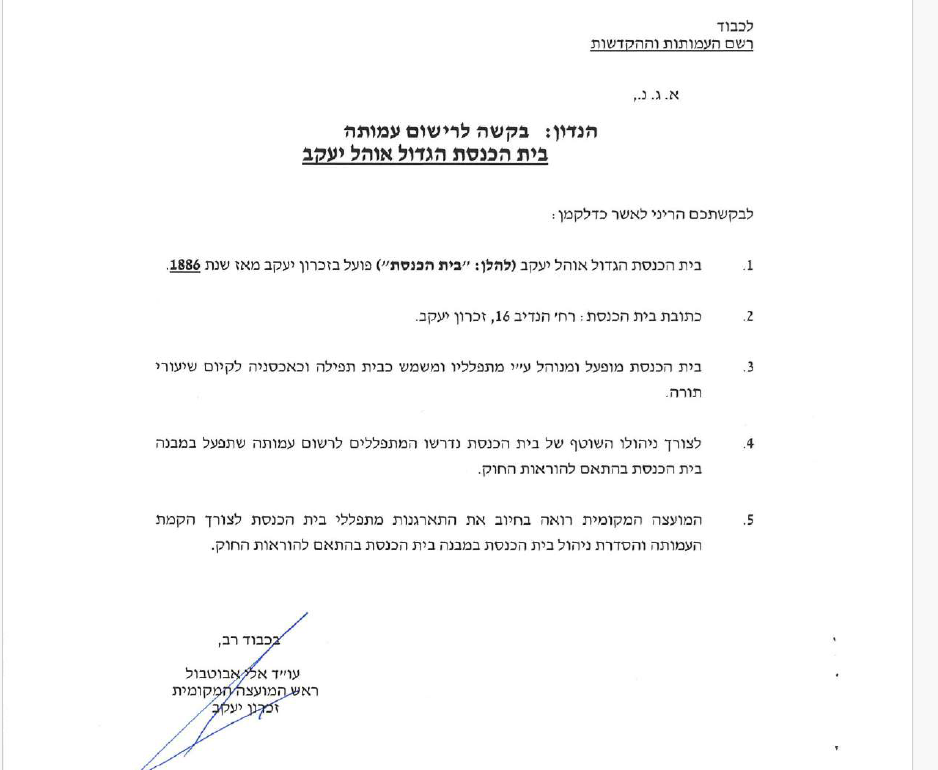
Worse still, note sections 4–5 of the letter, in which the council head declares his intention to allocate the Great Synagogue to the association. Yes, to allocate a national heritage site to a committee of worshippers. But this is a national heritage site that also belongs to those who did not vote for the council head. Moreover, such a declaration “taints” any future allocation process because the council head is stating in advance, on his own initiative, that he wants to allocate the historic building.
A property that is a national heritage site must not be allocated to the association. It must not even reach the council’s allocation committee. It’s that simple.
