Limor Zer Gutman
Council member
Lemaan HaMoshava Party
לימור זר גוטמן
חברת מועצה
סיעת למען המושבה
December 12, 2025
Hello everyone,
This is an ongoing failure; there are no answers and no completion date. At a meeting I held a few weeks ago with the Deputy Mayor, I was allowed to review some of the project documents, but I am still waiting for a critical document regarding this project. So, since August, I have been waiting for answers regarding this project.
Summary of the current newsletter—No. 65!!
First topic: The mayor surprised us by announcing that he had decided to withdraw Zichron Yaakov from the joint employment zone slated to be established in the area opposite Zichron. The sudden announcement prompted me to investigate what is happening there
At the beginning of the last meeting, during the mayor’s report, the mayor dropped a bombshell—he announced that Zichron Yaakov had withdrawn from the joint employment zone with Hof Carmel, Jasser, and Pardes. The zone, which our council has been working to establish for several years, will be established but without Zichron Yaakov. The council head explained that Zichron Yaakov would work to establish its own employment zone in the same area on a limited amount of land it owns. (Approximately 75% of the land is owned by the Israel Land Authority/JNF)
The explanation given by the council head for the sudden and surprising resignation is that because the Zichron Yaakov Council is not advancing the Zichrona neighborhood, the Israel Land Authority is intentionally delaying the development of the joint employment zone. Therefore, he decided to resign to allow Hof Carmel to develop the employment zone without delay. He explained that the Authority is able to delay the process because most of the land in this employment zone belongs to the Israel Land Authority.
According to the council head, Zichron Yaakov owns private land within the same complex (land owned by the council and private individuals)—and we will proceed with the development and establishment of an employment zone exclusively for Zichron Yaakov. The Authority will not be able to delay this because it is not its land. The council head did not specify what infrastructure work needs to be done, where the sewage or water lines will connect, whether an investment in updating the plan is required, whether the private plots are concentrated in one area, etc.
I am still in shock from the announcement. For years, we have been promised—including by the current council head—how good and important the joint employment zone is. How it will save Zichron Yaakov because we will finally receive property taxes from businesses that will enrich the community’s coffers. And after years of planning—it is suddenly halted. There is no discussion in the council, no data is presented—the mayor decides on his own, tossing out an unclear or perhaps incorrect reason during the meeting. Council members aren’t given all the facts, and the submissive coalition members don’t even raise a question—this is how the town is run.
I checked the council head’s statements last week—and found the following data on the Planning Administration website: Even in the part of Zichron Yaakov where the Zichron Yaakov employment zone is supposedly to be built, there is a lot of state-owned land. It’s not all private land, as he told us at the meeting. So the Authority could also delay the development of the Zichron area. So why did we leave? Additionally—in my estimation, by the time we reach the stage in the development of the Zichron Yaakov employment zone where the joint employment zone stands today after years of planning, many years will have passed anyway, and the development of Zichron Yaakov will begin (according to the court ruling). So what good does withdrawing from the joint zone do for us? In any case, we’re at the Administration’s mercy.
I have attached to this newsletter the appraisal conducted for the complex, including a list of plots held by private owners (available to the public on the Planning Administration website). Go straight to the table on page 18 of the appraiser’s report. It shows that, contrary to the council head’s statements, only 80 dunams of Zichron’s area are privately owned lands. For example, the company Amiri Gan, owned by developer Oded Turgeman (serial numbers 11, 12, 18, 19, 20 in the table)—see who the private owners are.
So I really don’t understand the reason for the sudden resignation, especially since we approved the appointment of the Employment Zone Director just a few meetings ago. Perhaps someone from the coalition will wake up and demand answers and information—because no one is answering me; I’m being boycotted.
Second issue: Approval of land allocation on Etzion/Zohar Street to the Moad Association
Who is eligible to apply for the allocation of public land (or a building) from the council free of charge?
Any nonprofit operating in Zichron Yaakov for the public good, registered as a nonprofit for at least 5 years, holding a certificate from the Registrar of Nonprofits regarding proper financial management, and demonstrating that it has the funds to finance the construction of a building (involving many millions) or that it is requesting the allocation of an existing public building. Thus, the nonprofit must present commitments for donations toward the construction of the building (the full list of criteria is available at the Council Secretariat).
The application is submitted to the Allocation Committee, which consists solely of professional staff: the secretary, treasurer, legal advisor, engineer, and the council’s property manager. All are senior council employees.
The committee reviews the request, seeks clarifications, publishes a public notice regarding the planned allocation, and invites objections; if any objections are received from the public, the committee reviews them. This is a lengthy process designed to ensure that the right land is allocated to the right nonprofit organization. Because public land is not up for grabs.
The Allocation Committee submits a recommendation to the full council, which alone has the authority to decide whether to transfer the public land to the nonprofit. If the full council approves the allocation recommendation, there is an additional process in which the allocation is approved by the Ministry of the Interior, which in turn verifies the validity of the procedure and other matters.
The allocation we approved at the meeting in early December is for the “Moad” community association, headed by Rabbi Yair Silverman, a community currently operating out of 100 HaMeisadim (the old Ya’avetz School).
According to the documents provided to us, the association will establish “a synagogue that brings together new and veteran immigrants based on communal and liberal values… The synagogue serves as a central hub for broad daily community activities and is not merely a physical space for prayer alone. The building is intended to actively serve the entire population…” In addition to the synagogue, the building will include classrooms and offices.
The request to the Allocation Committee was submitted in 2023, and the committee held several meetings on the matter. The process also involved addressing objections filed by some of the neighbors adjacent to the property. The objection, filed through an attorney, led to discussions between the association and the neighbors and to agreements that were reflected in the Allocation Committee’s decision, which we approved yesterday.
I reviewed all the numerous documents we received in preparation for the meeting, including the objection filed, the Allocation Committee’s decisions, the detailed plans for the building’s reconstruction, and more. I personally got to know some members of the Moad community after October 7 and was impressed by their significant contribution and the assistance they provided to the initiative I led in delivering cakes and pastries to soldiers on weekends.
We all voted in favor of the Moad Association receiving a half-dunam plot from the open public area of Block 11321, Parcel 46, on the southwest side of the parcel. This is on Etzion/Zohar Street, near the Alma Hotel. On this land, it will build a two-story building that will blend in with the existing neighborhood homes. There will also be 9 parking spaces on the building’s grounds. Not a lot of parking, but the maximum that can be accommodated on the site. Even after the allocation, the council still retains the remaining public land on this parcel.
Best wishes to the members of the Moad community. Good luck with the construction of the new building, which will serve as a home for the association’s wonderful activities that combine Judaism, Zionism, and liberalism.
Third topic: A query I submitted: An association seeking to use a council building
Many associations lack the financial capacity to build their own new structure. Even though they receive the land from the council, the construction costs are very high, and on top of that, the maintenance of the building must come from the association’s funds. Unless it is a synagogue, in which case the religious council shares the costs.
Therefore, many associations prefer to rent a council building under a “use agreement.” This is particularly true for sports associations, which usually prefer to rent a field owned by the council on specific days and at specific times. The local council has public buildings that allow for “dual-use” operations. That is, the buildings serve multiple functions at different times, such as for sports, education, religion, etc.
At the last meeting, I received a response to an inquiry I submitted on your behalf:
Here is the response I received:
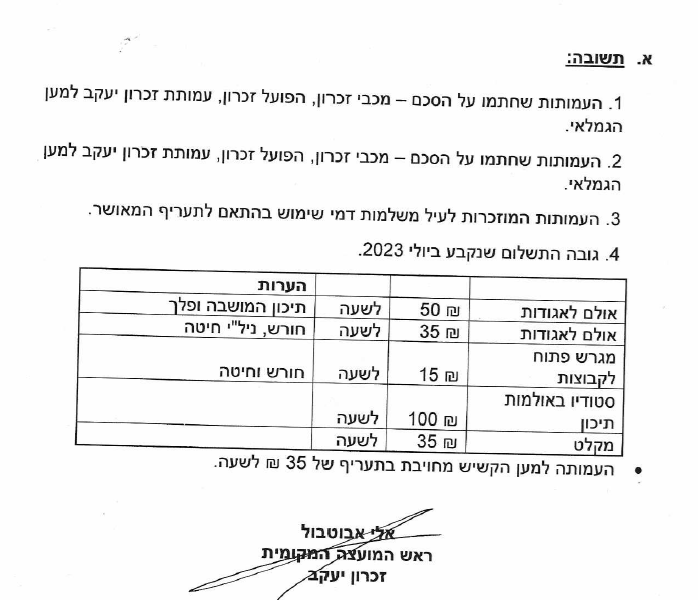
I submitted this inquiry because disclosing this information will help other non-profits, who can now submit a similar request. The council’s buildings belong to the entire public—and it is important that the public use them. Additionally, it helps understand how the council interacts with various non-profits. I know there are non-profits and organizations that use public buildings but were not mentioned in the council head’s response (why??). I will continue to follow up.
I’ll mention that in addition to the discounted rent for the council building, non-profits can also apply for financial support from the council’s funds. I’ll write about this in a future newsletter.
Fourth Topic – Hanukkah
This Hanukkah, we will mark the 143rd anniversary of the moshava’s founding.
The Council, the Community Center, and the First Aliyah Museum have organized a variety of activities in honor of Hanukkah and the moshava’s anniversary. The public is invited to join the various activities. Stay tuned for announcements.
Happy Hanukkah and congratulations on the 143rd anniversary of our beloved moshava. May we succeed in preserving it and its unique character for generations to come.
