Limor Zer Gutman
Council member
Lemaan HaMoshava Party
לימור זר גוטמן
חברת מועצה
סיעת למען המושבה
January 23, 2026
Hello everyone,
On 2/3/26, the Council meeting will be held as usual at 6 p.m. Those who have already attended a meeting know how important and beneficial their presence is—both for themselves and for the public. Mark your calendars and come! Next week I’ll send out the updated agenda.
Three topics today:
This issue is another piece of the puzzle regarding the construction of the Great Synagogue’s event hall on historic public land that is a national heritage site. Read more about this important revelation as part of my fight against this destructive plan, which, if carried out, will cause irreversible damage to the history of early settlement and a national site as defined by the state.
First issue: Road paving in the community
This week, Jabotinsky Street was paved. Funding for this came half from the Israel Electric Corporation and half from the local council. The Israel Electric Corporation carried out excavation work along half of the street to regulate the electricity supply for the “Founders’ Courtyards” residential and commercial project, whose construction is currently being completed. As is customary when the Israel Electric Corporation or the water utility digs up a road, they are required to repave it at their own expense. Since we will not leave a road half-paved, we approved a budget at the meeting to complete the paving up to the intersection with HaNidiv Street.
I would like to remind you that the section of HaMeisadim Street from Shufersal Square to the Yishai Gate was assigned to us by the Council Head and will be completed by the contractor of the “HaMeisadim Courtyards” project immediately upon the completion of construction there. Again, this is a standard procedure where a contractor, due to development and construction work that damages or wears down public infrastructure because of the heavy engineering equipment and trucks brought onto the construction site, is responsible for restoring the infrastructure.
The “Villas in the Grove” project, which began in August 2025, has finally reached completion, with Shazif Street now paved or about to be paved. Here, the entire funding came from the council’s budget. I remind you that I had reservations regarding the approval of the funding sources. I repeatedly contacted the treasury department, and Deputy Council Chair Tzila met with me to discuss the matter. I still have not received the full budgetary information, so I contacted the Ministry of the Interior. This week I received a final response from the Ministry of the Interior’s representative overseeing the local authority—a rather strange response that does not align with the factual data.
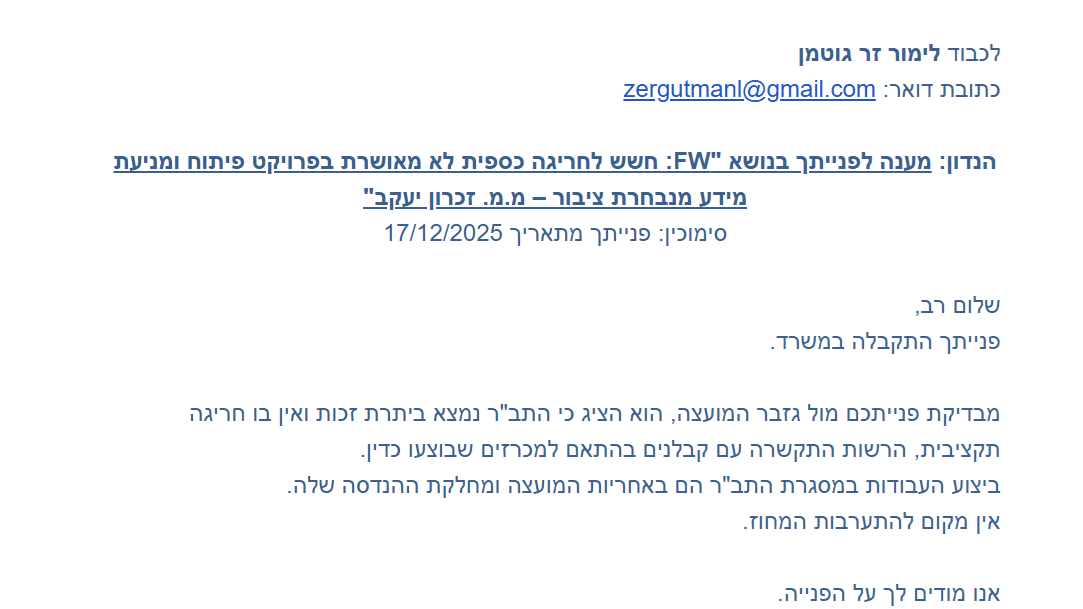
A report to the public states that there are plans to repave Begin Road. I checked, and the full council has not yet approved the budget for this project; furthermore, the agenda for the upcoming council meeting sent to us does not include a budget item for the project’s approval, and all approved funds are earmarked for specific projects. According to the Ministry of the Interior’s guidelines, a request for budget approval must be sent to council members 10 days prior to the meeting—which is why the issue is not on the agenda for the upcoming meeting.
It is true that when it comes to infrastructure rehabilitation, all council members vote in favor because it is in the community’s best interest. But I do so only after reviewing the funds to ensure there is money available for such a significant expenditure. So, before I had checked and before we had voted, the council had already announced the paving. Will it be carried out without budgetary approval by the plenary? If so, this is improper, and we must not return to a situation where tens of millions of shekels were spent without a defined budgetary source and without the Ministry of the Interior’s approval.
Second issue: Accelerated construction contrary to the master plan
If we thought that building density and floor area ratios were being increased in violation of the master plan only at the corner of HaNassi and Oranim Streets, reality shows that this troubling phenomenon is not limited to other areas.
This time, it is in the Neve HaMa’ayan neighborhood in the northern part of the town, in the area of Apricot, Finels, and Yigal Alon Streets. In this neighborhood as well, they are approving exemptions for additional units or granting three stories across the board to the plan, as well as various other exemptions such as a reduced number of parking spaces and more.
We must remain vigilant and demand that our representatives on the Regional Committee represent the public interest, not the interests of developers and stakeholders.
Third issue: Exposing the violation of the law and the false statement made by the council head to council members regarding the Great Synagogue on the pedestrian mall—Ohel Yaakov.
The Ohel Yaakov Great Synagogue was built in 1886 by Baron Rothschild and is located across from a public park owned by the council, though it is operated and maintained by the synagogue committee. Adjacent to the synagogue is a plot of land that currently features a large tree and benches (public open space). The synagogue committee is requesting this area to build a conference/event hall where they will hold, for a fee, Shabbat Chatan meals, refreshments for Bar Mitzvahs, study sessions, and more.
About 10 years ago, during Abutbul’s previous term, the Haifa District Committee unequivocally rejected the plan to build on the national site. Upon his return to office, he resubmitted the same plan without informing or obtaining approval from council members to submit it! Furthermore, the plan did not pass the council’s preservation committee, as required by the Planning and Building Law for any structure designated for preservation, and the National Sites Preservation Council was not notified.
I was the only one who voted against the plan. But I want to believe that if the council members had had the true information before them, more people would have opposed it, as these are fundamental violations that indicate a lack of proper administration and disregard for the law.
My handling of this plan revealed another astonishing fact that I can only report to you today. I delayed reporting this to you because for a year I have been waiting for the council’s legal advisor—Attorney Yossi Barzilai—to address and rectify this violation of the law. Below are my communications with him on the matter:
And here is the issue regarding which I have not received a response for over a year:
The association registered its address at 16 HaNadiav Street, Zichron Yaakov. This is the address of the synagogue, which actually belongs to the local council. The association cannot list its address at a property that does not belong to it and has not been allocated to it. This is an illegal act.
The Registrar of Associations would never agree to register the association’s address at a property that does not belong to you or that has not undergone an allocation process or other legal procedure. Unless the property owner—which is the Council—agrees to it. Therefore, on March 6, 2024, I paid a fee and received all the documents the association submitted during its registration process. Among the information I found at the Registrar of Associations, I found the Registrar’s letter dated June 4, 2024, in which he requests that the association “provide a written authorization from the property owner permitting the use of the property for synagogue activities, including the exact address of the property, signed by him.”
In response to this request, the head of the local council sent a letter to the Registrar of Associations that began with the words: “In response to your request, I hereby confirm the following.” The letter from the head of the local council stated that the association operates at 16 HaNadiav Street, Zichron Yaakov. Without this letter, the Registrar of Associations would not have recorded the property’s address as the association’s address.
Strangely, the letter is not on the council chairman’s official letterhead, bears no date, and no one from the council administration is copied on it—and most importantly, no officials are copied!!!
In this letter, the mayor is allegedly violating the law by granting unlawful authorization. This may be why the letter is not on official letterhead and may not have been brought to the attention of the council’s professionals. At the council meeting on February 4, 2025, Council Member Yigal Hakar asked how it was possible that the association’s address was the address of a property not allocated to it. You can listen to the recording, the highlights of which are provided above, and hear how the council head is allegedly not telling the truth in order to cover up the alleged illegal action he carried out. Below are the relevant excerpts from the meeting recording:
Council Chairman: No, not at all; nothing was allocated.
Council Member Yigal Hakar: I’m asking you; I’m asking the legal advisor
Council Chairman: What? What do you want to ask?
Council Member Yigal Hakar: The association uses it; the association’s address is the synagogue. I know there was no allocation, so how
Council Chairman: You might be right; I don’t know, I don’t understand this, I can’t tell you. You might be right, and the address can’t be there.
I’ll say that, on the face of it, it seems to me that land that wasn’t legally allocated—the association can’t register itself as if it were its own property. I agree from a legal standpoint and from the perspective of a reasonable person. Yossi (the legal advisor) will come and say that it’s not reasonable and tell her to change the address.
Following these events, I contacted the Council’s Legal Advisor on February 6, 2025. To this day, I have not received a substantive response to that inquiry. After receiving no response by March 6, 2024, I paid a fee and, a few hours later, received all the documents the association had submitted during its registration process. There I found the council chairman’s letter to the Registrar of Associations, and the truth suddenly became clear to me.
First conclusion: According to his letter, the Council Chairman, acting on his own initiative and without any legal authority, gave his consent for the association to register its address at a property belonging to the Council. In my legal opinion, the Council Chairman committed an illegal act that exceeds the authority granted to a Council Chairman. This constitutes a violation of administrative law and may even constitute a criminal offense of breach of trust.
Second conclusion: The council head did not tell the truth at the council meeting when he explicitly stated that he did not know how the association’s address was the property itself belonging to the council. The council head continued to lie brazenly by saying that the legal advisor would look into it, even though he already knew there was nothing to investigate because the illegal action had been approved by him—that is, by the council head.
Third conclusion: There are two possibilities here, each of them serious. The first is that Legal Advisor Barzilai was allegedly aware of the illegal authorization granted by the council head in his letter to the Registrar of Associations. He knew and did nothing, even though it was his duty to prevent violations of the law by the council head.
Since the council’s legal advisor, Attorney Barzilai, did not provide a substantive response to any of my inquiries on the matter, a second possibility arises: the council’s legal advisor should have been aware of this fact, which is contained in a document that is so easy to obtain from the Registrar of Associations. And the legal advisor failed in his duty. If he was not aware in advance of the letter to the Registrar of Associations, from the moment the issue was raised at the meeting on 2/4 and certainly after the email I sent him on 2/6: he should have looked into the matter. And even after the reminder dated February 23, 2025, the question arises as to whether he turned a blind eye and refrained from conducting a simple check that would have taken only a few minutes. And thus allowed the council chairman’s illegal act to proceed.
All my attempts to get a substantive response from the person responsible for law enforcement at the council have failed. A month ago, I personally hand-delivered my February letter to the council’s legal advisor and had him sign for it. Hand delivery and proof of receipt are required for filing a petition. (Copies were provided to several other officials.) At this stage, Attorney Barzilai realizes I have no intention of backing down and will file a petition. And then he responds to me. And look at the insolent reply, which actually does not address the problem I exposed at all. Instead of immediately addressing the violation of the law a year ago, Attorney Barzilai does not respond, shuns me, and continues to remain silent even as I prepare to file the petition. Here is what he replied to me a month ago in an email also copied to the official in charge at the Ministry of the Interior.
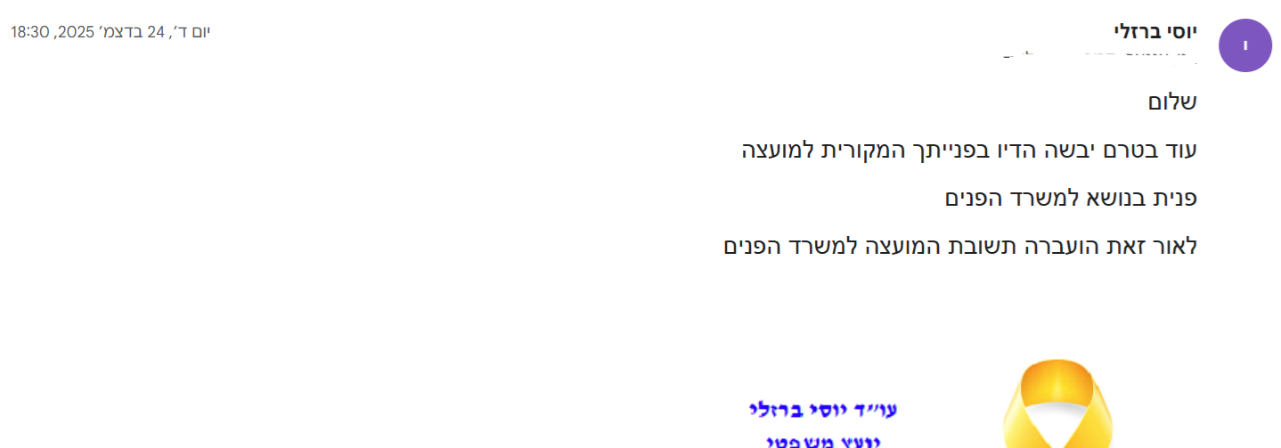
As you can see, the council’s legal advisor is “punishing” me for doing my job and refuses to send me his response, which was forwarded to the Ministry of the Interior, even to this day.
He apparently doesn’t like the fact that after a month of not responding to me, I checked the association’s file myself, located the problematic letter from the council head, and rushed to report the violation of the law to the Ministry of Justice and the Ministry of the Interior.
