Limor Zer Gutman
Council member
Lemaan HaMoshava Party
לימור זר גוטמן
חברת מועצה
סיעת למען המושבה
March 6, 2026
Hello everyone.
This newsletter covers several topics, as detailed below, but first I would like to commend the security and rescue forces and the hundreds of thousands of reservists for their efforts in safeguarding Israel’s security. I also wish to express my gratitude to the citizens of the country and all the residents of Zichron Yaakov for their spirit of volunteerism and the resilience they have demonstrated. Please take care of yourselves and your loved ones, and let’s wait for good news.
Here is the summary:
In this newsletter and its predecessors, and as you will read today in the topics I am raising, the same disturbing picture emerges of a council controlled by a single person, where nothing exists except his will and his decisions. And once again, I must state the obvious: the council—comprising the council administration, council staff, council committees, and the full council—exists because it plays a vital role in decentralizing power and authority. This is how a democracy functions; there is no place for the authoritarian rule of a single individual, even if that person is the council head.
First Issue: The Regional Planning and Construction Committee has suspended its discussion regarding the event hall on the grounds of the Ohel Yaakov Synagogue
In the previous newsletter, I reported to you about my urgent appeal to the Baron Regional Planning and Construction Committee, which was scheduled to discuss on February 19 the plan submitted by the council head to build an event hall on the historic grounds of the Ohel Yaakov Synagogue, which has been declared a national site. My letter to the committee revealed that, in submitting the plan, the council allegedly concealed and omitted (or suppressed?) essential factual information that must be presented to the Regional Committee when it deliberates on the plan.
1. The Haifa District Planning and Construction Committee issued two opinions, in 2016 and 2021, in which it categorically rejects any construction or plan of the type proposed today.
2. The committee was not presented with—or was concealed from—the fact that there are two recent expert opinions from the field of preservation opposing the construction of this event hall. The first is an opinion from our local council’s preservation consultant, which was indeed attached to the minutes of the Council’s Preservation Committee, and an opinion from the Council’s representative for site preservation, which was not attached to the minutes of the Preservation Committee. Both opinions strongly oppose the mayor’s proposal, while the Council for Site Preservation proposes an alternative that benefits the national site.
I am now continuing to update you because it appears that my letters, which exposed the council’s seemingly illegal conduct (concealing material information when submitting a construction plan), led to the following decision, which appears in the minutes of the Regional Committee meeting held on February 19, 2026—minutes I had been waiting for. And this is the decision:
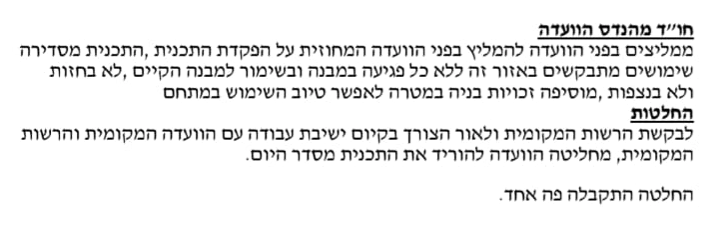
The minutes reveal that the Regional Committee’s engineer was already in favor of the plan. Thus, had I not appealed to the Regional Committee and made it clear that essential information had been withheld from it—the plan might have been recommended by the Regional Committee to the District Committee at that very meeting.
I reiterate: I will not allow the council head to destroy a national historic site. As noted by the Council for the Preservation of Sites, which opposes the plan—there are alternatives that nurture the site, preserve it, and do not harm it. This is a historic area that must remain so for future generations. At the same time, I am continuing to address the letter of legal doubt submitted by the council head to the Registrar of Associations regarding the synagogue.
I will, of course, continue to monitor the situation, as I have no doubt that the council head will submit a revised plan to the committee with the aim of allowing bulldozers to enter the historic site.
Second topic: 15 items will be brought up for discussion at the council meeting this coming Tuesday, March 10, 2026. Below is the agenda. You will find the detailed agenda with the accompanying documents attached to this email. Please review it and send me any questions or comments you may have.
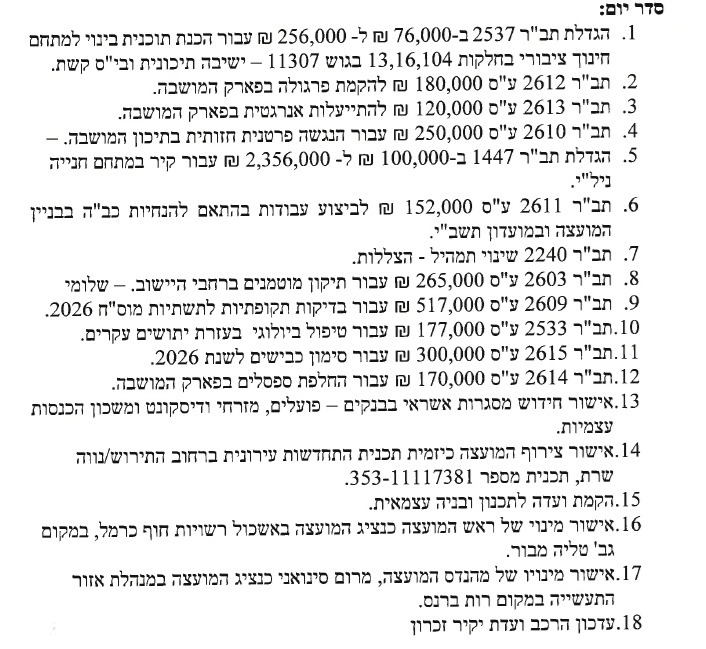
Third topic: I would like to urgently highlight Item 14: The mega demolition-and-reconstruction project on HaTirosh Street
Here is a reminder of what I wrote in Newsletter 73—this is a mega-project involving 135 units, plus additional land designated for dozens more units, as well as space for an office tower and vast commercial areas within a small plot, A project that will transform the face of the Neve Sharett neighborhood and will also greatly impact the adjacent Halomot neighborhood, as traffic congestion will shift there. And clearly, we are all in favor of demolition and reconstruction; clearly, we are all in favor of improving the difficult housing conditions of the residents. However, I hope it is clear to all of us that such a process must, above all, be lawful, orderly, and transparent to all council members and the public. And this process is far from transparent. Important materials and information have not been provided to us. And it seems that there is more hidden than revealed….
I will not repeat here all the many flaws in the plan, as I have already listed them for you in a detailed document attached to Newsletter 73. Since then, I have continued to examine the matter with lawyers who specialize in demolition-and-reconstruction projects. From what I have examined, a series of highly suspicious facts have emerged. And here they are:
Legally speaking, the council does not become a project developer before signing an agreement with the developers. An agreement that is in its favor and not in the developers’ favor. But—we haven’t received an agreement. And even if they suddenly wave an agreement at the meeting—I need enough time to let experts review the agreement.
There is a lot of missing information, many binding agreements we haven’t seen. With such a massive project, we must not rush. Rushing benefits the developers and harms the residents, especially those in the Neve Sharett neighborhood, and also harms the tenants whose apartments are part of the project.
You understand that I am going to vote against it. I hope that other council members who read this newsletter and those who hear me at the meeting will join me. This time, I will not let the mayor silence me or threaten to remove me from the meeting if I continue to speak—as he did at the previous meeting when we discussed the plan. By law, as a council member, I have the right to speak for at least 10 minutes on every item on the agenda. And I intend to make full use of that time.
If you know any council members, please remind them that they and I are elected officials who do not work to advance the interests of real estate developers. And even if the council chair says everything is fine, and even if the legal advisor, Attorney Yossi Barzilai, sits in the meeting and doesn’t say a word—it’s not okay!!
Fourth issue: We’ve been in a state of emergency for a week now, and to this day the Security Committee and the Passover Emergency Committee have not convened—which is absolutely essential!
This committee is mandatory by law and pursuant to the Local Authorities Ordinance. The committee’s primary role, as stated on the council’s website, is: “The committee is responsible for organizing and operating the council’s emergency response.” The committee consists of council members, public representatives, and professional staff. The emergency units and the emergency headquarters have been functioning well over the past week, but this does not negate the obligation and necessity to convene the committee.
How is it possible that the council head, who is the committee chair, is not convening it? There is a sufficiently large shelter in the council building that can also accommodate the committee members. In my view, this is unacceptable!!! The council head does not manage the emergency system alone; he is supported by professionals whom we occasionally see in photos published by the council. And to them must be added this mandatory committee as well.
Fifth issue: Item 14 on the agenda—the establishment of a local planning and building committee.
At the upcoming meeting, the establishment of a local planning and building committee for Zichron Yaakov will be put to a vote. In other words, a separation from the regional committee of the Baron communities and the establishment of a committee solely for Zichron Yaakov. A similar move was made by Pardes Hanna-Karkur a few years ago.
During his term, Ziv Deshe initiated the establishment of an independent committee and also received the support of the council administration and the Ministry of the Interior for the move. However, the opposition at the time thwarted this move. At a plenary session held on March 1, 2022, council members from the opposition led a resolution to cancel the move to establish an independent Planning and Construction Committee for Zichron Yaakov. These are the people who voted at the time to cancel the establishment of the independent committee: Tzila Reshef (currently Deputy Mayor), Dudu Barans, Aryeh Polak, Meir Liani, Yehuda Broner, Keren Ili, and Tami Bar-Sheshet.
Yes, what you’re reading—this is the decision they spearheaded against the public interest. And now, because she’s become Deputy Mayor with a nice salary and some of them have become coalition members—suddenly they’ll vote in favor.
I am not the kind of opposition that exists solely to thwart the mayor’s initiatives. I act pragmatically and vote in favor of what is good for the community and for you. That is why I will vote in favor of an independent committee.
An independent committee will bring several benefits to the public: transparency will increase, the professionals will focus solely on Zichron Yaakov, and some council members will serve on the subcommittee once it is established.
Sixth issue: Strange things are happening in the committee for selecting Zichron Yaakov’s honorees, and why hasn’t this letter been distributed for two years?
The Zichron Yaakov Honorary Citizen Committee has been operating for about 15 years. The committee was established during previous terms under Abutbul and includes elected officials and public representatives; it is headed by Ilan Amrani (who was a member of my party but left it and joined the coalition). The committee has also convened during this term and made decisions regarding the awarding of the “Honorary Citizen of Zichron Yaakov” title. People whose nominations have been submitted are waiting for a response and the ceremony. Furthermore, the criteria for selecting honorary citizens were approved at the plenary session on September 10, 2025, during this term.
It is unclear to me what the substance of the requested decision is, as no background material was attached—but even if one wishes to change the committee’s composition or criteria, the decision of the committee elected by the plenary must be respected. Even if the council chair prefers that other people be selected to receive the award, he is obligated to respect the committee’s decision and the work it has invested and to hold the ceremony. The requested changes should only take effect starting in 2026.
Attached are the criteria established by the committee in 2024 during the current term.
